
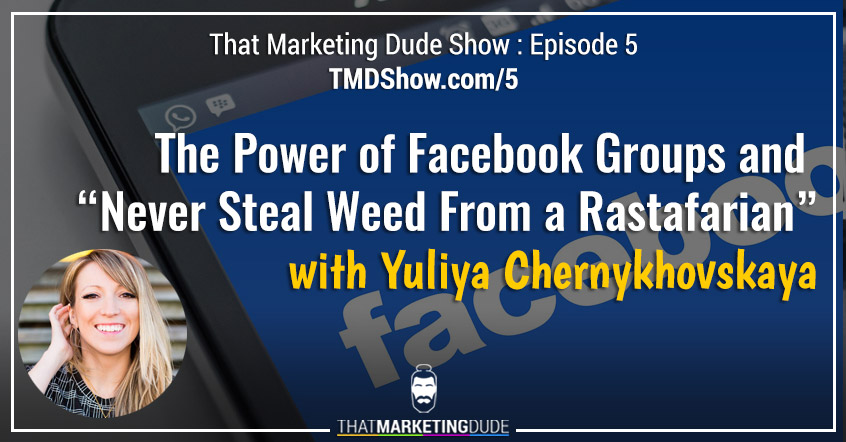
In today’s episode, I have a good friend of mine on today’s episode… Yuliya Chernykhovskaya! And yes… I said her name wrong 😛
Yuliya says, ” I’m a business strategist for health and wellness coaches, and so I really work with health and wellness coaches to help them set up the online portion of their coaching business. So we work through marketing; you know, sales strategies; sales confidence; mindset for success; how to actually coach people; and, you know, really make that a powerful machine.”
Yuliya is amazing… And crushes it in her Facebook group. This is the reason I wanted to bring her onto the show today to talk about Facebook groups and how awesome they really are!
IN THIS EPISODE WE COVER:
- Different ways to grow a group? Be helpful in other groups, have a banner (cover picture) on your personal profile linking to the group. Mention it on your podcast, in videos, in blog posts (have a URL to redirect to the group).
- How to bolster engagement.
- Being present in your group from the start.
- Themed posts (different views here!)
- How to promote your shit in an FB group. How it can help with market research too.
LINKS AND RESOURCES MENTIONED:
- Yuliya’s Website
- Yuliya’s Health Coach HQ FB group
- Canva
- Jarvis – Social media scheduler
- Dude Brood FB Group
===
Transcription:
LT: So, Yuliya, thank you so much for coming onto the show and co-hosting this episode with me.
YC: Yeah. Thanks for having me here. I am so excited to be speaking to all the digital nomads today.
LT: All the dudes and dudettes are so happy that you’re here. So in the intro I did introduce you to everybody, but would you like to introduce yourself, let everybody know a little bit about who you are, and, more importantly, how to pronounce your last fucking name. I’ve tried practising how to say it, but I’ve probably been saying it wrong so I’ll leave that to you. And then also let everybody know sort of, like, how you got to where you are right now and any sort of, like, travelling that you’ve done in the past as well.
YC: Yeah. For sure. So first I’ll start with my name. I hope that won’t take the whole five minutes. But my name is Yuliya, first of all, pronounced like Julia but with a Y. And the last name is Chernykhovskaya or Chernykhovskiy. So I’m Russian, and in Russian there’s, like, feminine and masculine last names. So the masculine are -iy and feminine are -aya. So there’s a fun fact that you learned today. So either one of those is fine. And I’m a business strategist for health and wellness coaches, and so I really work with health and wellness coaches to help them set up the online portion of their coaching business. So we work through marketing; you know, sales strategies; sales confidence; mindset for success; how to actually coach people; and, you know, really make that a powerful machine.
And how I got here, you know, it’s kind of a long and winding road. But, basically, when I was 20 years old, like, I had some serious health issues. So, like, the week that I was graduating college, I was told that at the rate I was going I’d have, like, an oxygen tank by the time I was 30 because my asthma was so bad. And so that really lit a fire under my ass to take my health seriously and really start taking care of actual health rather than, like, trying to be a certain pant size, which is what I thought health was prior to that. And so I became a nutritionist. I studied, you know, everything there is to know about nutrition; you know, eating well; like, a lot of Western medicine; Eastern medicine; really, everything. And so I kind of made it my mission at that point, you know, to pay it forward and to share with other people what I had learned, you know, and start up an online business.
And it was really difficult for me in the beginning because I had no clue, you know, what I was doing aside from the fact that, like, I really wanted to help people. And because of how much I struggled in the beginning, it’s kind of what, you know, lights my passion now because I was able to figure it out after, like, you know, being in it for a long time. And then I also have a background in sales and psychology and neuroscience that, you know, all kind of picked up along the way. It was kind of a crazy, like I said, winding road, but that’s really what brought me here, right. So, you know, along the way I also became a yoga teacher; a reiki practitioner; you know, worked in sales for a bit; really studied psychology; really studied neuroscience; and because I was doing a lot of these things simultaneously, was really able to see the big picture and weave them together and, you know, really use them in a powerful way which is, you know, what I teach to my clients now.
And so that’s really – it’s kind of crazy how I ended up here. Like, if you asked me even, you know, like, a couple of years ago, like, what are you going to be doing in two years, I would’ve never said this. But it’s kind of cool what happens when you find alignment with what you’re doing; everything just kind of falls into place and you realise, you know, everything that you did before made sense and kind of brought you here.
So as far as travelling, you know, my family and I immigrated here to the US when I was five years old because my parents won a green card in the freaking lottery. My boyfriend always laughs because he’s like, oh my god, Russia has a lottery to get out of the country. Like, you have to win something to get out of the country. And so I kind of, you know, was used to travelling from a young age, like, you know, going to Europe several times; like, you know, various places in the US and in Canada; and, like, you know, various, like, vacation tropical spots and things like that. So definitely love to travel, should definitely be taking more advantage of it with my location freedom now, but super stoked to share with you guys, you know, all of the things that I’ve learned along the way and share some outrageous travel stories with you as well.
LT: Oh yeah. You sort of, like, teased a little bit on what your travel story is going to be at the end of the rapid-fire session and, I tell you what, this is probably my most anticipated one that I really want to hear. Now, you’ve basically told me, like, five words and I’m, yeah, super excited to hear it. But first we need to drop some knowledge bombs for everyone, and we are going to be talking about Facebook groups. Now, I’ve been seeing you absolutely crush it in your Facebook group. I’m constantly seeing you going live inside there and, like, the engagement that’s going on in there, it’s just ridiculous. So hopefully we can help people to grow a Facebook group and also grow one that’s going to be super engaged, that’s going to help them out in their business like nothing else can. Are you up for that?
YC: Hell yeah. I am so up for that.
LT: Awesome. So I think the first thing that we should talk about first is, really, the difference – really quickly – the difference between a Facebook group and a fan page.
YC: You know, I get asked that question actually all the time. So let me just say, like, Facebook groups are one of the most powerful social media platforms right now. And so I’m super stoked to be sharing all this information with you guys because if you don’t have a Facebook group, get out a pen and paper and write down everything we’re saying. So the difference between a like page and a Facebook group is, you know, actually the way Facebook defines a Facebook group, it’s really a place to create a community for people who have similar shared interests, right. So you can create a group with people who like, you know, a certain book, like a book club, or a community group. You can even create a group, you know, for your family to share pictures and events and things like that.
And Facebook groups have certain privacy settings. So, you know, you can have a private group where only people in that group, you know, see who’s in that group and see the posts that they share, right. You can also have a closed group where, you know, anyone can find the group but you have to request access to actually see the content. And then you can have, you know, public groups which are a free-for-all. Ultimately, what you have to know is that Facebook groups are just, like, a freaking party with people who are passionate about, you know, the same thing or are learning about something, right.
LT: Yep.
YC: And so it’s a community. Whereas a like page is something where you just, you know, share information. It’s kind of, you know, the business version of a personal page, right. So you can use a like page to run ads, to share content, but it’s not necessarily a group setting; it’s just you kind of putting yourself out there, you know, and setting yourself up as a business or, you know, whatever else you want to use a like page for. I hope that makes sense.
LT: You’ve probably said that a lot better than I could. So you crushed it. You crushed it. So I think we should now quickly jump onto – well, not quickly; we’ll spend a little bit of time talking about, like, different ways that you can grow a Facebook group. And one of the best ways that I’ve found to grow a group, especially at the beginning, is to jump into other groups that are in a similar space. So for, like, myself, I’m in a lot of sort of, like, digital nomad groups and sort of, like, online business groups and just helping people. If I see questions, I’m helping people. And a lot of these groups, at least the good ones, they don’t let you sort of, like, self-promote, which is fair enough, you know. These people have created the group to help them out with their own business, which is essentially what you want to do, you know. You want to create a group and you don’t want other people coming in and trying to sell their shit in your group. So you shouldn’t be doing it in other groups as well.
And so, like, the trick or the tip that I have, which I know you implemented once I mentioned it inside of a group that we’re both a part of, and that is on your cover picture on your personal page, you know, if you’re helping people enough in all these groups, people are going to click on your profile and say, “Who the fuck is this dude?” or, “Who the fuck is this dudette?”
YC: Yeah.
LT: Like saying, “That’s, like, giving all this information who knows their shit; who the fuck are they?” And they’re going to want to find out more information about you. So they’re going to click on your name and go to your personal profile. And on there, what you want to do is your big cover image at the top, instead of having that as some random landscape picture or, I don’t know, some fucking picture of a dog or whatever it is, that is, like, prime real estate that you can pimp out your own group without breaking the rules of all these other groups.
So you can have a funky image there, and I know you’ve got a really good image on your profile, Yuliya, where you’ve got – well, you’ve got a picture of yourself; I’ve got a picture of my sort of, like, samurai head on there right now. And then you can talk about saying what your Facebook group is and then a link to it, and you can obviously link it in the description of the image but also have it written down, like, on the image itself. And that way, if people are interested and want to find out more information about you and your group, they’re going to go to your group and they’re going to request access to join.
YC: Absolutely. And, you know, you really want to ask yourself two questions before you even, like, start promoting your group, right. It’s, like, why am I creating this group? What’s the point of it, right?
LT: Yep.
YC: Like, how am I going to use this to move my business forward? And then once you have that question answered, okay, cool, now who do I want to attract? So those are really the questions you need to have figured out first because that’s, of course, going to help you come up with the name of the group and, you know, create a nice branded cover photo that’s going to attract that type of person. And - - -
LT: And it’s also going to help you find the groups that you’re going to be jumping into, participating into, as well.
YC: Exactly. And, you know, the crazy thing is, like, I’ve been in Facebook groups for a while and what I’ve found is that those that don’t allow promotion are the ones that move my business forward the most, because those are groups where people come to actually, you know, create relationships, build community, rather than just sell their shit. And so when you’re able to go into a group and add value, you know, like Luke said, people will have their eyes on you; they’re going to want to know who you are without you saying, “Hey guys, like, check out my group,” right. Like, it just speaks for itself. So definitely check out groups that really don’t allow promotion all too much because you will get more qualified leads and you will be less likely to attract people who just wanted to go to your group and sell your shit, right.
LT: Yeah.
YC: The other way in addition to the cover photo on your personal page, there’s also a part where you have your intro. And this is a really important piece of real estate because this is, like, your mini elevator pitch where you can say who you are, you know, and what you do and, again, link people to your Facebook group, right. So there’s two really good opportunities on your personal page to link to your group, and I always say, like, for me, I don’t recommend using your personal page to sell stuff because, by the way, you can get your account shut down for that. But you can use your Facebook page to share about your business.
LT: Yes.
YC: And that is the most powerful way to do it, with the intro and the group photo – I mean, the cover photo. The other way to grow your Facebook group is to really, like, put that shit on everything, right. So, like, if you’re, you know, on a podcast like I am right now, promote your Facebook group, right, and create a really nice URL for it, a nice domain name.
LT: Yes. Thank you. That’s the one thing that annoys me the most, is when people say, “Yeah, come join my Facebook group,” you know, it’s facebook.com/group/137589 – no. Fuck that. No. Pay $11 a year, $10 a year, and get a such-and-such group dot com or whatever you want it to be. Not only is it easier to tell people, but it looks much prettier when you see it as well.
YC: Absolutely. Like, if I told you guys, “Go to healthcoachHQ.com right now,” right, you’d be more likely to go than if I was like, “Yeah, join my Facebook group, go to my website, find the link,” or, like, you know what I’m saying.
LT: Exactly.
YC: So it just makes it easy for people to join. And so when you’re able to do that, it’s super easy to mention it on podcasts. You know, if you’re a guest blogger, you can do that. If you use Instagram, you can put it in your bio on your Instagram page and lead people to your group from your Instagram or mention it in a video. Basically, it makes it super accessible and super user-friendly. Another way is to actually tell people to share it with their friends or family who they feel would benefit from the group as well. So, remember, the point of the group is to build a community of users, right; a community of valuable members. So if they’re digging your information, chances are they know other people who would also. So tell them: “Hey guys, if you like what you see here, share it with your friends and invite them to join as well.”
LT: That’s perfect. Yeah. I mean, we’ve seen people grow, like, their own, like, six-figure, seven-figure businesses out of other people’s Facebook groups, you know, and, you know, you don’t need to be scammy or promotional and, you know, violate the rules that other people have set if you provide good content and have an easy way for people to find you. So if you can, like, do that, you know, create a nice little URL, be helpful as possible inside of groups and make sure your cover photo on your personal profile, like, links to that group and, you know, if you’ve got that sexy little URL – like, my one is dudebrood.com, which I mention at the end of all these episodes. You know, that is on my cover page. I have: “Want to link with other digital nomads and location-independent entrepreneurs? Go to dudebrood.com.” That takes you to my Facebook group; request access; done; you’re in.
So if you, like Yuliya said, plaster that everywhere online, people are going to be coming to it. So there isn’t really, like, a lot of ways that you can – like, without getting all scammy and, you know, disgusting on promoting your group, they’re probably, like, the best ways to do it. Would you agree?
YC: Absolutely. And, you know, with the name too, like, I love the name Dude Brood. It’s just so branded. So really take that time because, again, you’re going to be sharing that all the time, and the name is also going to attract people to you who are just like you, right. So also take some time in thinking of a really cool, attractive name; like, don’t just call it, like, Entrepreneur Group, right, because there’s, like, a million of them out there.
LT: You’ll be lucky – if you could get entrepreneurgroup.com, then you’ve won.
YC: Yeah. That’s right.
LT: If you could get that, then you’ve done well. But, yeah, you want something that’s, like, easily memorable and, you know, catchy as well and that, you know, people are going to remember it when they do get to their computer or when they go to their search bar or whatever. It needs to be easily memorable so they can type it in and find you.
YC: Absolutely. So now you got people into your group – and then what? Do you want to talk about engagement?
LT: Yes. So it’s all well and good that people have been able to find your group, but now we need to make sure that we’re engaging these people so they’re interacting with you and your brand and, you know, you’re warming them up to potentially buying something from you. And the thing that people – the people that start a Facebook group, the thing that they think is going to happen, it’s like, yeah, I’m going to get all of these people and they’re going to start talking to each other and it’s going to be awesome, blah, blah, blah. That’s not going to happen. You need to be present at the very beginning of your group because the conversation is not going to start themselves. Imagine you’ve just chucked a load of introverts into a room all by themselves; no one’s going to start up small talk, are they? No.
YC: Absolutely, right. Like, just because you’ve attracted people into your group, it’s a whole different game plan of how to actually keep them engaged, right, and keep them at this party. So you have to be the hostess with the mostess. And I think, you know, for me, one of the biggest and best investments of my time when I first opened up my group was, like, you know, just being in there all the time, engaging with my members, listening to the questions they were asking, right. Like, if I saw a question, I would make an entire post about that because you want to create relevant content, right, like, what are they interested in and what do they want to hear. And so asking questions; sharing value; you know, live streaming; doing polls. Like, truly make it a party because then people will never want to leave. And, you know, it’s good market research for you too because you’ll know what sort of paid content to create as well.
And also, too, prepare yourself for crickets. Like, I think that’s something that’s not talked about enough, that, you know, your group could be the best group ever, but in the beginning you can hear crickets and I just want to normalise that and say it doesn’t mean that your group sucks if you do hear crickets. Like, it does take some building up and a lot of time and growing the group in order for it to have organic engagement between the members as well. So even if you’re doing all of the things and you’re still hearing crickets in the beginning, you’re still doing a good job.
LT: Yes. Yeah, you couldn’t, like, start all the conversations, like, possible. You know, you can’t force people to, you know, converse with you. But, you know, it’s more likely going to happen if you are starting these conversations than if you just leave it up to their own devices.
YC: Absolutely. And, you know, one thing – this is, like, a little hack. But if you have any business besties, you can team up with them, right, and, like, let’s say your friends have a group, you have a group; you can engage in each other’s group, right. Like, no one wants to be the first one on the dancefloor; it’s the same thing with a Facebook group, right. Like, no one wants to be the first person to engage. So if you have, you know, friends who you’ve teamed up with to help each other engage in each other’s groups, it definitely helps that, you know, curve of people engaging as well. And my clients always make fun of me but I’m always like, “Tell your audience what to do. Just tell them what to do. Tell them what kind of, you know, posts to make, what sort of questions they can ask.” Like, be very specific, like, “Hey, share a win. Ask a question about social media. Like, you know, share a good book that you read the other week or an awesome podcast you listened to,” right. Like, tell people how to engage and they’ll do it.
LT: Yes. And I want to, like, jump onto something that is a little bit controversial between us because we both have completely different opinions on this, and that is the idea of using themed posts. And what I mean by themed posts is that you set up, like, an automated message that goes out to your group that is almost what you said about asking a question. You know, you can set these up to go out every single week. Now, at the beginning most people have the same sort of, like, seven posts go out Monday through Sunday. So every Monday, it would be, I don’t know, Monday’s Mantra where you post your favourite quote. And then Tuesday would be Tools Tuesday; post your favourite tool for whatever.
I agree with you, Yuliya, when we say that they’re done to death. But I think if you have, like, at least three to four weeks’ worth – which is something that I’m in the process of doing myself now. If you have at least three to four weeks’ worth, I think themed posts are a great way to start a conversation, if for whatever reason you can’t be there in the moment to start a conversation yourself. The reason why I say you should have at least three to four weeks is because people are not going to see the same thing over and over again. Like, every Monday they’re not going to see the same post.
So they’re not going to think that it’s the same – like, people are smart, you know. They’re going to know, like, it’s all going to be automated after a while. But if you’re posting the same question every single Monday, the people that have been in your group for a while, they’re not going to answer it every single week. So it’s important to have a nice variety, at least three to four weeks’ worth to start. I would say have three months’ worth so that people are going to see the same post four times a year. But to start off with, especially in a new group, three to four weeks. And that way, if for whatever reason you can’t, you know, ask a question live or, you know, do whatever in your Facebook group live, you know, you’ve got something to fall back on.
YC: See, that’s where I agree with you. Like, you know, I was telling Luke before we started recording that I really am not a fan of themed days in the beginning because what I see happen to groups that don’t do so well is that, like, they’ll open up their group, they’ll say, “Hey guys, join my group, like, this is fucking awesome,” and then they start with themed days right away and it’s, like, the same seven themes. And that’s the only value you see in the group. And then it’s just, like, boring and no one really is enticed to stay there, right. So what I tell my clients is, like, in the beginning you kind of want it to be a little bit like the wild west. Like, asking all sorts of questions; like, giving a bunch of different value; and seeing what sticks and what doesn’t, because then you have better data that you can use to create themed days that are unique to your group, right, that are really powerful for your audience. And, you know, like Luke said, like, you really want to mix it up; you don’t always want to have the same seven themed days over and over and over again in the beginning, right.
LT: Yeah.
YC: Like, if you have a huge group, right, I mean, that’s a whole different ballgame. But specifically in the beginning, I think you want to, you know, let it be a little wild and organic before you really create that automated structure, just so you can make it even more powerful.
LT: Yeah. And once you do get that conversation going and you know, you know, the things that people want to talk about and, you know, the things that people have in common, you can make, like you said, really, like, customised or customisable – you can make the themed days that are, like, specific to your group and it’s not going to be the same shit you see going out in all the other groups. And it doesn’t take that long to do either. You know, if you use something like Canva, you know, you can knock out three weeks’ worth of these pictures in 30 minutes. All you’re doing is swapping out the back image and changing the text. And if you’ve got all the ideas written down already, 30 minutes you’ve got that there. And then you can use something like Buffer – or I use a program called Jarvis, which a friend of ours created, you know, and then you can set it up so it gets posted into your group automatically.
But like Yuliya said, it is best to have it as the wild, wild west at the beginning so you can see these conversations so you can make better themed posts to be automated to go out. But where I think we differ is that I think you can do them at the beginning as well. But once you do have that information where you can make more customised themed posts, definitely go ahead and switch them up as soon as possible.
YC: Absolutely. Totally agree. I think, you know, just always keeping it fresh, keeping it exciting and keeping it new; that’s the way to go. And, you know, then your group members are going to love it.
LT: Yeah. I mean, we were – well, I don’t know if you saw this, but in a group that we’re a part of, somebody in there was just saying that they updated their themed posts for the first time, and they did that in the new year. And they said the instant engagement that happened once they saw, like – not only was it, like, better branded as well, but they were just completely different to the same shit that they were seeing every single week. Their group just instantly became alive.
YC: Totally.
LT: So definitely update them after a while. You know, if you do have one month’s worth, keep it like that for four to six months and then update them. Or if you’ve got three months’ worth, update them every year.
YC: And, you know, I forgot the name; there’s, like, a psychology term for this. But, like, when you see the same thing over and over and over again, you just tend to glaze over it and, like, just, like, not even see it. You know what I’m saying? Like, if you, like, drive by the same street every day, like, you might not even know the name of the street because you just, like, see it over and over and over again, the same thing. And so if you have the same themes or the same content over and over again, people will just kind of, you know, scroll by it without paying attention. So making it new and exciting definitely helps get attention and, as a result, engagement in your group. So I totally love that.
LT: Sweet. Now, I think we should move onto something that I think you are excellent at in your own group, and that is how you can promote your stuff in your Facebook group. And we’ve already mentioned it once, and that is sort of, like, how you can use your group for market research.
YC: Absolutely. So, you know, as far as market research, a lot of the times people think that market research is asking questions, which is definitely a part of it, but a big part of market research is just listening and seeing what people are saying, right. So rather than just saying, “What are you struggling with all the time?” I mean – which is great in the beginning, but it gets old after a while. You can just see, like, what sort of questions people are asking, what sort of topics are they pulled to, or saying, like, “Hey guys, I’m about to create a new offer. Here’s a poll. You know, which area do you need most support in?” right. So doing market research, listening to it, and then creating an offer that’s, you know, answering a pain point or an area where people are struggling with, right, that’s a sure way to get an offer that’s going to convert, rather than creating an offer, putting a bunch of time into it, and then you got no sales because nobody wants it, right. So that’s definitely the first part.
The second part of actually, like, okay, now you have an idea for an offer or you have a service. You know, maybe you’re a coach; maybe you have a digital product; whatever it is. How are you going to sell it now, right? There is a lot of different ways you can go about it, right. You can lead masterclasses on live stream; you can host challenges; you know, you can do all sorts of things. But it all boils down to showing up; giving a lot of value; bringing that know, like, and trust factor; but then also actually selling at the end and inviting people to go further, right. I think so often you just hear the former and not the latter, right. Like, I wish it was the case that you can just give people value all day long and they would just throw money at you all day long, but you do have to ask for the sale.
And so, you know, that’s really it. Like, what I have found most powerful in my groups is just, like, giving live stream trainings. It’s almost kind of like mini webinars all the time, right. Like, giving trainings; giving value; people love it; then you say, “You guys like this? Cool. Let’s take the next step. Like, here’s my offer. Here’s a link to book a discovery call. Here’s a link to check out my new group offering, right. Like, if you like this, check it out.” And so it’s definitely just giving value in a way that engages your group. And take some time to really figure that out, because for some people challenges work really well; they work really well for me. But for other people, they don’t work that well, right. So for other people, maybe you want to do longer live streams or maybe you want to do, you know, not video posts but written posts that engage people. But always give value and always ask for the sale at the end.
LT: And like you said, you know, Facebook lives are probably one of the best ways to build that like, know, and trust factor. And they don’t have to be that long unless you find – like, you can test it out and see if the longer ones do perform better for you. But you can give, like, a 15-minute, 20-minute training on whatever topic that people seem to be talking about a lot, not only in your group but, like, other groups that you’re a part of as well. And just, you know, deliver value. And once you’ve delivered value enough over time and people, like, begin to like you and see that you know your shit, then they are going to start taking you up on these offers. And like you said, it’s a bit like a live webinar, you know. Everybody talks about webinars as being sort of like the holy grail of making sales because you get to spend a decent amount of time with people, to teach them something or, like, give, like, a little mini masterclass; whatever you decide to call it. You know, you get to basically flaunt off your knowledge and show people that, “I know what I’m talking about with this topic; I can help you out.” And then you can then promote whatever it is that you want to promote. Like you said, you’ve got to ask for the sale. But I think Facebook lives is, like you said, a – it’s like the modern webinar or – I wouldn’t even really call it modern. Webinars are fucking, like, modern anyway.
YC: Yeah.
LT: But it’s just like the new version or the new way of doing webinars, and now they’ve got super fancy where you can – you know, when they first brought out Facebook live, it was all done through your mobile phone or your cell phone, whereas now you can use things like Wirecast and you can, like, put all this production value in and make them super fancy. But the cool thing is that you can create Facebook lives inside of the group, you know. A lot of people, you see them doing it all the time on your newsfeed, you know, off their personal profile. But you can create them specifically for people inside of the group, and you can say that, “This is only for you guys in this group right now,” and you can make people feel a bit special by doing that too.
YC: Absolutely. And by the way, that’s another great way to, you know, invite people to join your group is saying that you share these free, exclusive trainings in the group. You know, the way that I like to describe live streams, it’s like a webinar without fighting with technology, at least I always have that issue with a webinar. Like, it’s not a webinar if something doesn’t go horribly wrong, either the replay doesn’t send out or it doesn’t record or whatever the case may be. So I love live streams for that reason. And something that I wanted to include, just a really quick hack that you can use with your Facebook group if you’re running ads. So let’s say you are hosting some sort of, you know, webinar or you have an offer or an opt-in or whatever it is, and you want to use Facebook ads to target and you want to maybe target people in your Facebook group. And maybe you don’t have, you know, let’s say, an audience, like a huge email list that you can target with your ads.
So what you can do is you can go into the search bar of your Facebook page and you can write “favourite pages of members of Health Coach HQ”. So I can see what all of the members, like, in my Facebook group, I can see their favourite like pages. And then I can target those pages in my ads, without having to ask my group, “Hey guys, what books are you reading? Who are you listening to on podcast lately?” You know, like, I mean, those are fun questions to ask, but you can do really easy market research for your advertisements by just typing in “favourite pages of members of XYZ Group”. From there, you can even see what sort of content they like, right. Like, if a bunch of them are liking a certain page, okay, let’s see what that page is and what kind of content is being shared there, what kind of images are on that page that people are really engaging with, right. So that’s just another added layer of market research you can do with a Facebook group.
LT: That’s an awesome form of market research. I didn’t know that before we jumped onto this call, so I’m definitely going to be using that.
YC: Boom.
LT: Yeah. Boom. That’s an awesome tip. I’m going to make sure that’s put in the show notes for today as well. And the other cool thing which I’m not exactly sure when we’re going to be posting this interview live, but Facebook are sort of, like, toying with the idea of being able to do ads inside of groups anyway. So soon, you know, you can find the groups and the pages that people in your own group like, you know, and then you’ll be able to soon place ads into other groups like yours as well, which could again be a great way of drawing people to your group and to your products. I know that at the time of recording they have, like, started testing this out in some groups, but I’m not sure when they’re going to be rolling that out fully.
YC: Yeah. Totally. I can’t freaking wait for that.
LT: Awesome. So, Yuliya, thank you so much for coming on and talking about this topic. But before we go, we do have one last thing to do and that is the rapid-fire question session.
YC: Let’s do it.
LT: Are you ready?
YC: I am so ready.
LT: Awesome. So the very first question is: what is your favourite country that you’ve been to so far?
YC: Jamaica.
LT: What is the last YouTube or movie that you’ve watched?
YC: Oh crap. Man, I thought I was going to be good at this. I don’t remember. I watched a Russian movie last night.
LT: What is the weirdest thing that you’ve eaten?
YC: Russian sushi, as my mum calls it.
LT: What is your favourite drinking game?
YC: Cards Against Humanity.
LT: That is such a good one. If you could meet one person, living or dead, who would it be?
YC: The first person that came to mind was George Washington; I don’t know why. Let’s go with it.
LT: We don’t need a reason. Number six: name one book that you would recommend everybody should read.
YC: One book? Motivation Manifesto.
LT: What is your go-to song when you need to get into the mood to get shit done?
YC: Levels by Avicii.
LT: That’s so cheese. Number eight: what is your favourite swearword that you’ve learnt in another language?
YC: I don’t have one. Fuck. But I just love the word “fuck”.
LT: How do you say that in Russian?
YC: I don’t even know.
LT: Useless.
YC: Totally useless.
LT: Moving on. Number nine: what is your favourite podcast apart from this one?
YC: Eight Minute Millionaire, always.
LT: And then, finally, I’m looking forward to this one. Can you give me your best travel story you have in under five minutes.
YC: Oh yes. Okay. So I wasn’t originally going to share this one, because it’s a little naughty. But Luke wanted me to, so it’s all for you. I went to Jamaica with a couple of girlfriends. This was, like, a decade ago. And we kind of had split up and they had went on this guided tour; like, you ride on a horse and, like, see waterfalls and shit. And somehow it happened that they thought they were being cool and they stole, like, a huge bag of weed from this Rasta guy. And they thought that they could get away with it. And so – this is really scary. We’re eating lunch – so they come back and we decide to eat lunch together, and I obviously don’t know, like, what happened. And this guy who, like, seemingly worked at the hotel, he came up to us and he was just, like, “Oh, what room number are you?” And I kind of, like, hid my keys because it just kind of, like, intuitively felt off. And then my friend was like, “Oh yeah, we’re room XYZ.” He’s like, “Cool. I’ll see you there.” And we’re like, “What the hell?”
And so we, like, run up to our rooms and the phone starts ringing and I pick up and I answer in Russian because, like, the only people who could’ve been calling me were, like, you know, like, family. And so – and I was also kind of scared of that guy. And it was that guy, and I just, like, hung up the phone. And then they started, like, banging on our doors and we were hiding under the bed, and it was just, like, the scariest thing ever. And then, long story short, the next day I was – again, we split up. I used to be, like, the black sheep all the time. Anyway, again, we split up. I went to get a massage and my friends, they were supposed to get a massage after me, and then they kind of didn’t show up because we were supposed to, like, meet right after. And it turned out that, like, the Rasta guy had gotten in contact – I mean, you know, people there, I guess, are like all connected – or not all connected, but a lot of people are connected there. And they had gotten in touch with, like, the hotel and the girl that I was staying with, like, had to give the money to this Rasta guy, and everything ended up being gravy. But, like, thank god that that happened, otherwise who knows what could’ve happened. So moral of the story is don’t steal drugs from Rasta guys when you go on tours, and don’t go on vacation with people who steal drugs from Rasta guys when you go on tours.
LT: That is a very good lesson. Don’t go to Jamaica and steal weed off a Rastafarian.
YC: Yeah.
LT: That is one big no-no.
YC: It was so scary. And just, like, the banging on the door. Oh my gosh. But it was the best place ever to go on vacation, so as long as you keep it clean; just drink a piña colada. And if you want to do something like that, just pay for it and it’s all gravy.
LT: See, that was an awesome story to share. Thank you so much.
YC: My pleasure.
LT: So, Yuliya, thank you so much for coming onto the show. This has been an absolute blast. If people wanted to reach out to you online, whereabouts can they find you?
YC: So you can always find me hanging out in my Facebook group, Health Coach HQ, and you can find that at healthcoachHQ.com. Or you can find me on my website, yulirocks.com.
LT: Excellent. Thank you so much. And all of that will be in the show notes, so if you can’t remember those simple links you can go to the show notes page and it will all be there. So, again, Yuliya, thank you so much for coming onto the show today. It’s been an absolute pleasure, and I can’t wait to finally meet you in person in Texas next month.
YC: I can’t wait. Thank you so much, Luke. It was a blast being here. Thank you, guys.
LT: Take care.
YC: Bye.
- END OF TRANSCRIPT -


